Digital Safety & Scam Awareness
Protecting Our Church Family Online
Scammers frequently target church communities across the country because they know congregants are generous, caring people who are always ready to jump in and help when a need arises.
We want to empower you to navigate your inbox safely. By learning a few simple rules, we can work together to protect your personal security and safeguard the privacy of our entire First Presbyterian Church of Naples family.
1. Our One and Only Email Domain: @fpcnaples.org
Church pastors and staff members will only ever send official correspondence from an email address ending in @fpcnaples.org. This is the only email domain you should ever trust when communicating with our team.
Beware of Lookalike and Free Email Accounts
It is very easy for a scammer to type a pastor's name into a free email service, but it is much more difficult for them to fake our official website address. When reviewing your emails, always look past the "Display Name" and check the actual email address in the brackets:
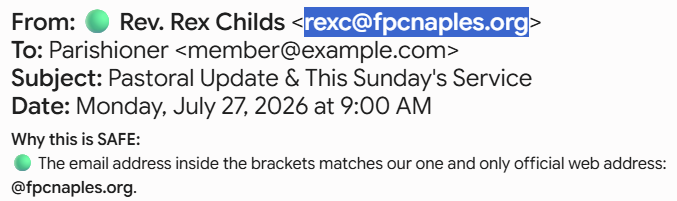
- Real & Safe: Rev. Rex Childs <rexc@fpcnaples.org>
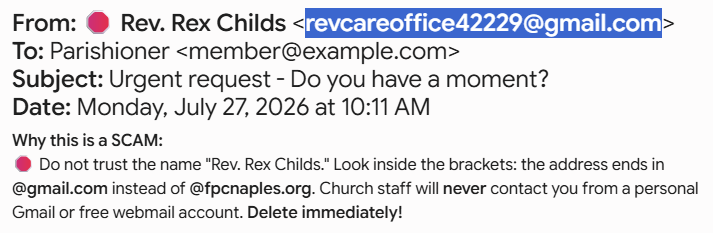
- Scam (Free Account):
Rev. Rex Childs <revcareoffice42229@gmail.com>
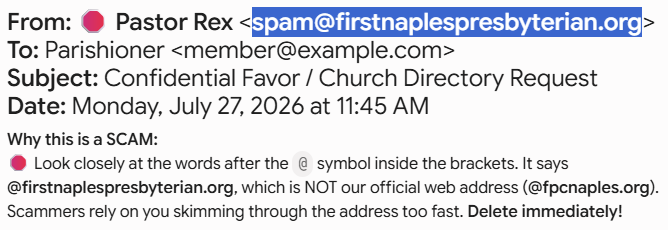
- Scam (Lookalike Domain): Pastor Rex <spam@firstnaplespresbyterian.org>
The Golden Rule: Never trust a sender by their display name alone. If an email claiming to be from church staff comes from a Gmail, Yahoo, Hotmail, or lookalike address, it is a scam. Do not reply, and delete it immediately.
✅ REAL & SAFE: Official Church Email
When you open an email from church staff, look at the sender's details at the top of the message. The name may say "Rev. Rex Childs," but the most important part is the address inside the brackets. It must end in @fpcnaples.org.
🛑 SCAM: Free Email Account (Gmail / Yahoo)
Scammers can type a pastor or staff member's name into the "Sender Name" box to fool your eye, but it is more difficult for them to fake our official email domain. Look at the address inside the brackets—if it says @gmail.com, @yahoo.com, or @outlook.com, it is a scam.
🛑 SCAM: Lookalike Web Address
Some sophisticated scammers will register a fake web address that sounds very similar to our church name to trick people who are reading too quickly. Always read the domain spelling carefully!
2. What Church Staff Will NEVER Ask For
To keep you safe from financial fraud, our leadership team has established strict communication boundaries. No member of the First Presbyterian Church of Naples staff will ever send an unexpected email or text message asking you for:
- Gift Cards: (such as iTunes, Amazon, Google Play, or Visa gift cards)
- Digital Currencies: (such as Bitcoin or crypto wire transfers)
- Urgent Monetary Transfers: (such as ATM withdrawals, Venmo, or bank routing requests)
- Secretive Favors: (messages saying "I need your help urgently, but I am in a meeting and cannot talk on the phone")
Note on Compromised Emails: Even in the extremely rare event that an email appears to come directly from a valid @fpcnaples.org address requesting gift cards or urgent financial favors, do not proceed. Church staff will never ask you for these items unless it was previously discussed with you in person. Always verify by phone before taking action.
3. Phone Call & Text Message Safety
Scammers also attempt to impersonate church leadership via text message and phone calls. Please keep the following safeguards in mind:
- Cell Phone Outreach:
Church staff members will almost never contact you directly about official church business from a personal cell phone number.
- Caller ID Spoofing: Modern scammers have the technology to make a fake call look like it is coming from a local number. If you ever receive a suspicious phone call asking for money, personal details, or immediate action, hang up immediately.
To verify any phone communication, always call our official office lines directly:
- Church Office:
239.262.1311
- Preschool Office: 239.262.8315
4. Protecting Parishioner Privacy: The Directory Rule
One of the most common church scams involves attackers trying to get their hands on member contact lists so they can target more people.
Please protect your fellow parishioners: Never share church membership directories, PDF contact lists, or private member contact information with anyone who requests them via email. If someone asks you for another member's contact details, please refer them directly to the church office.
5. Why Am I Receiving These Emails?
When you receive a spam email from a Gmail account or a lookalike web address pretending to be a pastor or staff member, it is understandable to worry that someone has broken into the church’s computer network.
We want to clarify that receiving an email from a fake or lookalike address almost always means someone is copying our names and church details—it does not mean someone has broken into church computers or our official email systems.
Scammers take public information—such as staff names and leadership roles listed on our website or in our Sunday bulletins—and set up fake accounts on their own. Whether they use a free service like Yahoo or register a similar-sounding web address to trick the eye, it is strictly an external impersonation attempt. Think of it like someone writing a staff member's name on a fake return address label and dropping a letter in the mail. While we continuously work to safeguard our technology infrastructure, understanding this difference helps us all recognize these messages for what they truly are: simple, external attempts to impersonate our church leadership.
6. What to Do If You Accidentally Responded to a Scam
We understand that scammers are clever, and anyone can be caught off guard. If you accidentally replied to a suspicious email, clicked a link, or purchased gift cards, please do not feel embarrassed—we are here to support you. Take these immediate steps:
- If you shared financial information: Contact your bank or credit card company immediately to flag the activity and freeze the affected account.
- If you bought gift cards:
Call the customer service number on the back of the cards right away to see if they can freeze the funds before the scammer drains them.
- If you clicked a link or opened an attachment: Run a security scan on your computer or device using your antivirus software.
- Let us know: Call the church office at 239.262.1311. We can keep an eye out for any follow-up scams targeting you and reassure you on next steps.
7. When in Doubt, We Are Here to Help!
We always prefer that you ask a question rather than risk dealing with a scammer. A phone call or verification check is never a burden to our team!
If you ever receive an email, text, or phone call that feels rushed, unusual, or suspicious:
- Do not reply, click any links, or download any attachments.
- Forward the suspicious email
to our verification inbox at: fpc@fpcnaples.org
- Call the church office directly at 239.262.1311 to speak with a staff member.
Mark as Spam and Delete: After forwarding the email to us for verification, use the "Report Spam" or "Junk" button in your email program, then delete the message entirely. This helps train your email provider to block that scammer from reaching other church members!
No Request is Too Urgent to Wait: Scammers want to pressure you into acting before you have a chance to think or call for help. Please know that no real request from church staff will ever be so urgent that it cannot wait until regular business hours. If you receive a strange message when the church office is closed, do not reply or send money. Wait until Monday morning to call us—we promise that if a pastor truly needs something, it can wait!
Thank you for your vigilance and for helping us keep First Presbyterian Church of Naples a safe, supportive community!
Last Updated: July 2026